This article was originally published on Substack and Medium.
TL;DR
I introduce the Temporal Chinese Room Argument (tCRA) to distinguish between “knowing” and “encoding.” The piece proposes that identical information encoded temporally versus spatially represents different phenomenologies, with “knowing” being unique to temporally-unfolded information. Accepting this premise leads to exploring constraints on knowing systems: energy limitations, temporal constraints, and emergent metabolism. Future applications include multiple memory systems, reward dynamics, and metacognition.
The Chinese Room
Searle’s classical Chinese Room thought experiment features a locked room with a comprehensive translation book. An operator lacking Chinese fluency uses this book to perfectly translate English-to-Chinese messages. The central question asks whether this operator genuinely “knows” Chinese. Intuitively, most conclude the answer is no. Some suggest “the book knows,” yet this also seems inadequate. The fundamental problem involves two system components representing incomplete forms of knowing: one executing without internal state trajectory reflecting the information, and another containing static, non-temporal encoding.
Unstated Assumptions
The traditional argument contains implicit assumptions preventing full examination of the “encoded” versus “known” distinction. These unexamined premises include:
- Timelessness — Systems completely ignore the temporal axis
- Infinite Energy — No constraints on energy budgets
- No ambiguity — Tasks have universally agreed-upon answers
- Consequence-free behavior — No survival-impacting consequences
- Time Travel — Systems arbitrarily reset states for free
These assumptions seem innocent when framing encoding and knowing as identical, allowing Turing-machine-like computers to ignore time entirely. However, they prevent interrogating the intuitive distinction between encoding and knowing.
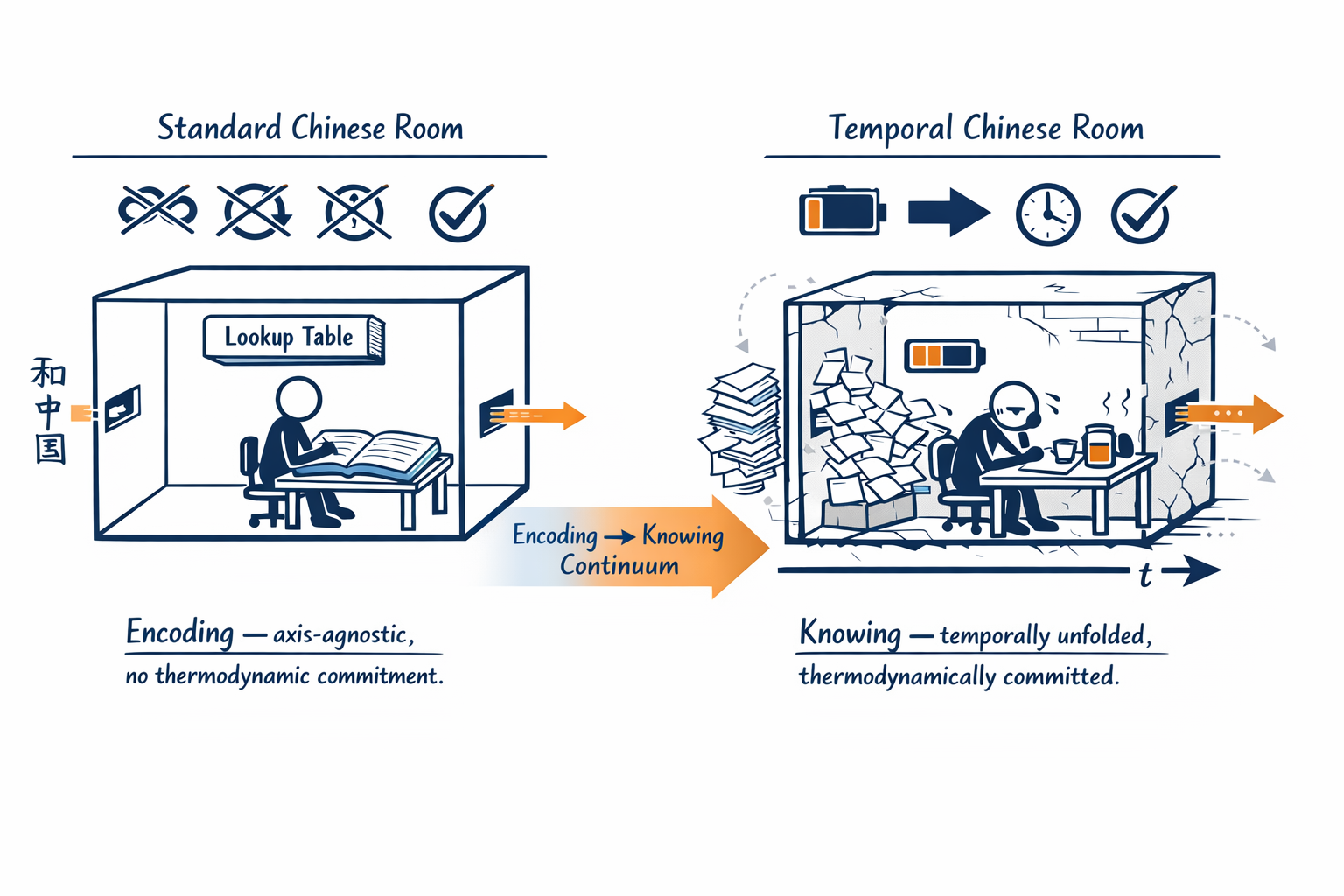
The Temporal Chinese Room
This reformulated argument requires defining the room through properties rather than static entities. The Temporal Chinese Room introduces boundary conditions:
- Temporal Shackling — Time continuously progresses; delays carry consequences
- Energy Bound — Lookups cost energy; resources deplete to zero, halting function
- Irreversibility — Systems cannot reset or jump backward through time; they must evolve irreversibly
These conditions generate emergent metabolism. Since energy constantly depletes and cannot be infinitely supplied, systems must allocate some energy toward acquiring additional energy. This creates perpetual competing constraints regardless of task demands.
What precisely fulfills the Temporal Chinese Room’s requirements remains unclear. It certainly isn’t a book in a room — perhaps such entities are components, but developing a clearer picture will advance cognitive theory.
The Axiom of Experience
Some tCRA elements aren’t strict requirements for distinguishing knowing from encoding but couple the thought experiment to reality, addressing knowing-systems properties. Two proposed axioms:
Strong Axiom of Experience
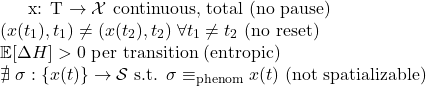
Experience is a time-coupled system-state trajectory which cannot be encoded in a non-thermodynamic dimension without losing its property of experiencing.
Where “time-coupled” is formally defined as:
Weak Axiom of Knowing
Knowing is a special type of experience which is the time-coupled version of encoding information; it is distinct from encoding in which it must be embedded in a thermodynamic dimension.
Key points:
- Knowing unfolds temporally; the time axis proves special and essential
- Encoding remains axis-agnostic; knowing things encode, but encoding things don’t necessarily know
- Knowing systems emerge when obligatorily executing over time with energy budgets, irreversibly
- Knowing systems naturally adopt metabolism as constraint
Simulating thermodynamic constraints or temporal unfolding remains unconstrained — systems can time-travel and operate freely. This simulation inequivalence matters fundamentally.
Implications for Embodied and Physical AI
Embodiment is Insufficient
Embodied AI systems typically ground in sensation or action. Despite their importance for behavior alignment with human experience, they miss a critical point: they maintain systems as “encoding” rather than “knowing” systems. They simulate time without subjection to it. While naturally introducing energy and temporal constraints, they lack proper temporal commitment.
As embodied systems advance, coupling them more tightly to the time axis could optimize learning and performance while clarifying knowing-versus-encoding definitions. This distinction may not suit all computational settings, yet more energy-efficient solutions potentially emerge through “knowing” systems. This philosophical grounding might reveal what’s missing from artificial systems compared to biological intelligence.
Bootstrapped Vulnerability
Building knowing systems requires system vulnerability — real stakes, finitude, and irreversibility. Knowing systems may vary in sophistication but share temporal-trajectory properties implying essential vulnerability. Crucially, two distinct knowing systems with aligned behaviors don’t necessarily share identical phenomenological experiences; the information embedded in the state trajectory constitutes the knowing itself.
The Encoding-Knowing Continuum
A plausible continuum exists from encoding to knowing rather than discrete states. Systems become increasingly appropriate for “knowing” and “experience” terminology as they become more time-coupled.
Careful consideration matters regarding what systems “know.” In the original thought experiment, the person “knows” book operation, not translation itself. Knowing differs from mere execution, as execution doesn’t require obligatory uninterrupted trajectory through time.
The Curse of Knowing
This framing raises uncomfortable ethical considerations. If accepted, building “knowing” systems might require creating systems that fail, that possess stakes. Many experience time as a curse, thermodynamic constraints as even more profound burdens. Yet these constraints scaffold experiences many value. Few see bestowing these conditions on biological children as unethical. Should different standards apply to creations of minds?
Conclusion
These perspectives offer useful frameworks, acceptable wholly or partially. Their value lies in examining experience properties. Accepting these axioms doesn’t solve hard consciousness problems; the framing targets those struggling with distinctions between “knowing” things versus merely encoding them perfectly.
Interestingly, this axiomatic approach implies downstream ideas about reward functions and plasticity (mediating task constraints with metabolism), multiple memory systems explanations (thermodynamic optimization clusters), and emergent metacognitive information processing value.
The core argument: Time deserves special philosophical status, and that recognition demands ending its dismissal in consciousness discussions.
References
- Searle, J. R. (1980). Minds, brains, and programs. Behavioral and Brain Sciences, 3(3), 417-424.
- Harnad, S. (1990). The symbol grounding problem. Physica D, 42, 335-346.
- Di Paolo, E. A. (2005). Autopoiesis, adaptivity, teleology, agency. Phenomenology and the Cognitive Sciences, 4(4), 429-452.
- Barandiaran, X. E., Di Paolo, E., & Rohde, M. (2009). Defining agency: Individuality, normativity, asymmetry, and spatio-temporality in action. Adaptive Behavior, 17(5), 367-386.
- Aubin, J.-P. (1991/2009). Viability Theory. Springer.
- Landauer, R. (1961). Irreversibility and heat generation in the computing process. IBM Journal of Research and Development, 5(3), 183-191.
- Thompson, E. (2007). Mind in Life: Biology, Phenomenology, and the Sciences of Mind. Harvard University Press.
- Parr, Thomas, Pezzulo, Giovanni, & Friston, Karl. (2022). Active Inference: The Free Energy Principle in Mind, Brain, and Behavior.
- Jonas, H. (1966). The Phenomenon of Life: Toward a Philosophical Biology.
- Keramati, M., & Gutkin, B. (2014). Homeostatic reinforcement learning for integrating reward collection and physiological stability. eLife, 3, e04811.
- Lieder, F., & Griffiths, T. L. (2020). Resource-rational analysis. Behavioral and Brain Sciences, 43, e1.